New Women and Babies Hospital Project
Please review the following information in detail. This information can also be downloaded via the links at the bottom of the page. This website should be viewed on desktop rather than mobile.
The website is intended to take you through the EOI steps as follows:
Read the Project Information page (this page), including reviewing the online briefing
Review the Artwork Briefs (each brief can be read individually, or downloaded as a single PDF)
Preview the EOI Form & read the FAQs
Click Start the Expression of Interest to submit
Each page has a button to proceed to the next step at the bottom right.
1 New women and babies hospital project
1.1 Public Art Expression of Interest
WA Life are seeking Expressions of Interest (EOI) from artists and creatives for a series of significant public art commissions for the New Women and Babies Hospital Project.
The project will deliver modern health care facilities that will support Western Australian families for generations to come. This EOI process will establish a pool of artists who may be shortlisted or directly engaged for a range of commissioned artworks for the project.
The commissions include sculptural works, integrated artworks, printed graphics, painting, digital works and photography. Artists of all levels of ability and disciplines, including those from non-traditional public art disciplines are strongly encouraged to apply. This includes (but is not limited to) illustrators, painters, print makers, photographers, furniture makers, craftspeople, ceramicists, textile-artists, poets and writers, digital media artists, sound and lighting artists, as well as sculptors and traditional public artists. The project features several ‘design only’ commissions well suited to early career and non-traditional artists, as well as major stand-alone commissions.
1.2 About the New Women and Babies Hospital Project
The landmark New Women and Babies Hospital Project is set to expand services and choice for women, newborns and their families across Western Australia replacing the century-old King Edward Memorial Hospital. The project will deliver contemporary healthcare facilities and support families for years to come, and includes:
A new state-of-the-art Women and Babies Hospital within the Fiona Stanley Hospital (FSH) precinct;
A major expansion of Osborne Park Hospital.
WA Life, part of the Webuild Group, is the Managing Contractor for the New Women and Babies Hospital Project.
More information about the project can be found here: New Women and Babies Hospital | Building for Tomorrow
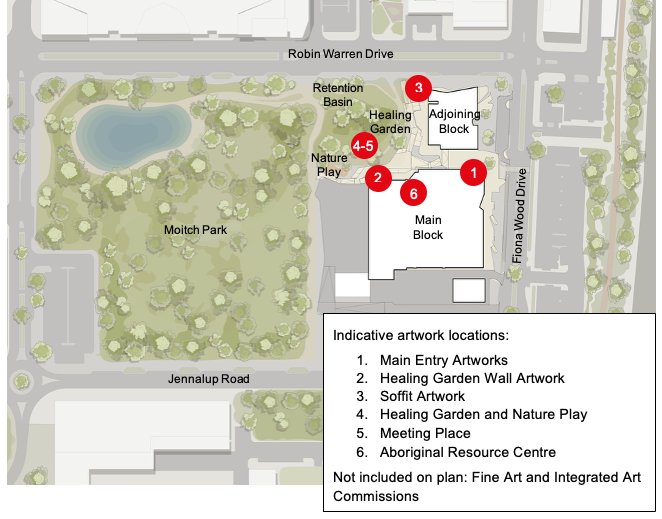
Women and Babies Hospital
The new Women and Babies Hospital will include:
Inpatient facilities for gynaecology and maternity patients;
A neonatology unit for newborns needing specialised care;
Operating theatres
A family birth centre; and
Outpatient clinics.
The hospital's design prioritises access to natural light and views of the surrounding landscape, with internal spaces being planned to enhance comfort and wellbeing.
Outdoor areas will provide spaces for care, rest, and connection for patients and visitors.
The architectural design is driven by a landscape-led response to site conditions and a salutogenic approach to healing, delivering a complex operational facility that prioritises the wellbeing of patients. Two built elements are proposed modulating between a main 12-storey block and an adjoining smaller six-storey block which will house a family birth centre, parent and patient accommodation and a sanctuary.
The goal is to create a facility that supports the delivery of person-centred care. It aims to create an environment that is conducive to the delivery of high-quality clinical care, supports family connection, and provides spaces for quiet reflection.
Sustainability principles will underpin the design of the new hospital and health facilities.
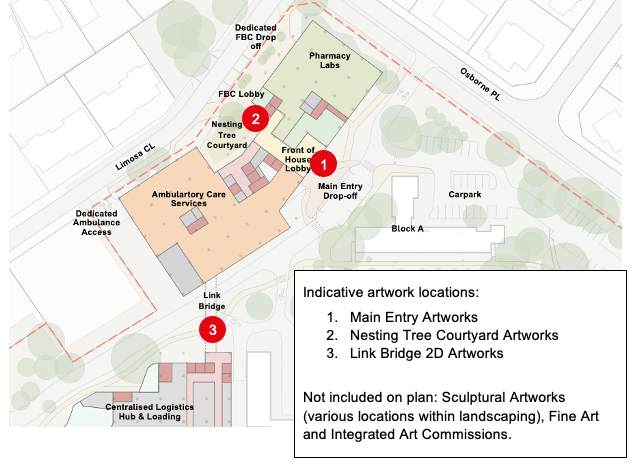
Osborne Park Hospital
A major expansion of Osborne Park Hospital is also part of this project.
This expansion means more families will be able to experience high-quality maternity care at Osborne Park Hospital. It will also introduce a mother baby unit for the first time to provide care for women experiencing mental health illness during pregnancy and in the period post-birth.
The hospital will also gain a new family birth centre, which will have its own independent entry separate to main hospital, providing a home-like environment and offering more birthing choices for women and families.
1.3 Public art at the hospitals
As a result of the State Government’s Percent for Art Scheme public art is now a key part of all public buildings in Western Australia. The scheme is a State Government initiative that started in 1989. It is managed by the Department of Housing and Works in partnership with the Department of Creative Industries, Tourism and Sport (CITS).
Detailed Public Art Plans have been developed for each of the hospital sites and detail the project context, sense of place, public art objectives principles and priorities. Relevant extracts from the Public Art Plans have been incorporated in these briefing documents.
The complete Public Art Plans for each hospital will be provided to the shortlisted artists at concept design stage.
1.3.1 Public Art Objectives
The public artworks will be commissioned with the following guiding objectives:
Healing environment: Artwork supports wellbeing, comfort, and recovery for patients, families, and staff.
Community connection: Artworks help regional visitors feel connected to home while acknowledging Whadjuk Country.
Cultural responsiveness: Where appropriate, Aboriginal cultural elements are inteegrated to reflect both Whadjuk country and the statewide Aboriginal communities served at the hospitals.
Accessibility: All artwork is inclusive and accessible to diverse users, creating a welcoming atmosphere.
Wayfinding support: Artistic elements assist navigation and orientation within the facilities.
Legacy integration: Honour the history and legacy of King Edward Memorial Hospital in Subiaco.
1.3.2 Guiding Principles
The following guiding principles will provide overarching guidance throughout the procurement of artworks:
Clinical integration: Artwork must enhance rather than compromise clinical functionality, meeting all healthcare facility requirements for hygiene, safety, and operational efficiency.
Community representation: The art program must reflect the diversity of communities served, with particular attention to Aboriginal women from regional and remote areas who comprise the majority of accommodation facility users.
Cultural integrity: All artwork must demonstrate appropriate cultural consultation and respect for Aboriginal protocols, particularly recognising the sacred nature of women’s birthing knowledge and practices.
Durability and maintenance: All artwork must be designed for longevity within healthcare environments, with clear maintenance protocols and appropriate material selection.
Collaborative approach: Artist selection and concept development must involve meaningful collaboration between creative practitioners, clinical staff, and community representatives.
1.3.3 Public Art Priorities
Public artwork opportunities have been identified in line with the following priorities:
Wayfinding and design integration: Artistic elements will guide visitors to essential services, while creating moments of calm and orientation within the clinical environment. Artworks enhance the built form and landscape through integrated or additive components, rather than competing with the addition of new forms.
Clinical environment enhancement: Artworks are integrated within clinical areas to supports stress reduction, family bonding, and healing processes, with particular attention to birth rooms and Neonatal Intensive Care Unit family areas.
Regional connection: Artworks within accommodation and family areas help visitors from regional and remote communities feel connected to their home country while acknowledging their presence on Whadjuk land.
Cultural anchoring: Significant artworks by Aboriginal artists at key locations and gathering points immediately communicate cultural welcome and respect. These works will be developed by Aboriginal artists with appropriate cultural knowledge and community endorsement.
1.3.4 Commission Types
Artwork opportunities include design and construction commissions as well as design-only commissions, as per the below definitions:
Design and construct: Artists are contracted to design an artwork and will also be responsible for the fabrication, delivery and installation of the work/s.
Design-only: Artists are contracted to deliver only an artwork design, often in the form of a digital file, which will be fabricated or reproduced by others. This is particularly relevant for commissions such as large-scale graphic vinyls or façade treatments. Design only commissions provide opportunities for early career artists from diverse backgrounds such as illustration, photography and poetry.
2 KEY DETAILS
2.1 Who can apply
There are no restrictions to artist locations, however criteria will preference artists with strong connections to Western Australia and to the two hospital sites. Artists of all levels of experience including hobby, early-career, mid-career and established creatives are encouraged to apply.
Individual artists, artist teams and community groups and organisations may apply.
Several artwork opportunities reference cultural content. Only artists with cultural authority (for example Whadjuk Noongar artists) may apply for the opportunities which reference cultural content. These will be specified in the briefs on the following pages. The remaining commissions are open to artists of all backgrounds.
Given the nature of the services offered at both the new Women and Babies Hospital and Osborne Park Hospital focus on women, newborns and their families – women and female-identifying creatives are strongly encouraged to apply.
2.2 How to Apply
Before applying, it is critical that you review the EOI briefs found on the following pages.
All applications must be made by completing the online form before the closing date and time. No late submissions will be accepted.
The ‘EOI preview’ section below provides a summary of what you need before starting the form. It is recommended that you prepare this information prior to starting your EOI submission.
For assistance with making a submission, please contact the project’s Public Art Coordinator, Kate Parker: kate.parker@slrconsulting.com
EOIs close on 6 July 2026, 5pm AWST.
2.3 Online briefing
An online briefing was held on 4 June, 10.30am AWST. This was an opportunity to hear more about the project and to ask any questions about the Expression of Interest process.
The recording of the meeting can be downloaded here: EOI BRIEFING LINK.
2.4 Selection Process
EOI Review: A review of the EOIs received as a result of this call out will be undertaken to ensure all required information has been submitted.
Shortlisting: A public art selection panel will review the submissions and determine shortlists for each artwork opportunity. Submissions will be assessed against the following criteria:
Quality of previous works: Artist/s demonstrate a high level of artistic excellence based on previous experience. Artworks are aesthetically engaging.
Capacity: The artist’s portfolio demonstrated the capacity of the artist and team to deliver high quality artworks.
Relevance and connection to site: Artists demonstrate a connection to the site. Artist’s work is relevant for the context, demonstrated through past works, and an understanding of the site context, local community, and curatorial themes.
Shortlisted artists will be invited to develop Concept Designs. Artists may also be directly appointed for commissions.
Concept Design Development: Shortlisted or directly appointed artists will be provided with a detailed briefing document including a budget for the artworks. A period of 4-6 weeks will be allowed for the development of concept design proposals in response to the briefing document. The development of concept designs is a paid process; shortlisted or directly appointed artists will receive a fee for the submission of complete proposals.
Artwork Selection: The Public Art Selection Panel will be responsible for the review of the concept design submission and will select the preferred artworks for each opportunity.
Contracting: Artists will be contracted to WA Life for the delivery of the artworks.
2.5 EOI Preview
The EOI form will ask you for the following information. You are encouraged to prepare this information prior to commencing the next step:
Artist name or team name.
Contact information.
Your level of experience (multiple choice question).
Your language group (if any).
Your ABN (if you have one).
Your website or Instagram (optional, this will not form part of the assessment).
The types of medium you currently use (multiple choice question).
Which opportunities interest you most (multiple choice question).
A statement reflecting your connection to either site (WBH or OPH) and/or to Western Australia. This statement can be written (maximum of 250 words) or uploaded as a video or audio recording (maximum of 2 minutes).
A statement reflecting your approach to the opportunity. This statement can be written (maximum 250 words) or uploaded as a video or audio recording (maximum of 2 minutes).
A CV to be submitted as a single PDF (maximum 2xA4 pages, single page layout).
Examples of past work to be submitted as a single PDF (maximum 10xA4 pages, single page layout).
2.6 Handy Hints for applying
Make sure you have all the information ready to go before you submit
Do not submit documents longer than the maximum sizes indicated. Any pages beyond the maximum page length will be deleted and will not be reviewed. As we expect a large number of submissions this page limit is critical to ensure all submissions can be reviewed in detail.